
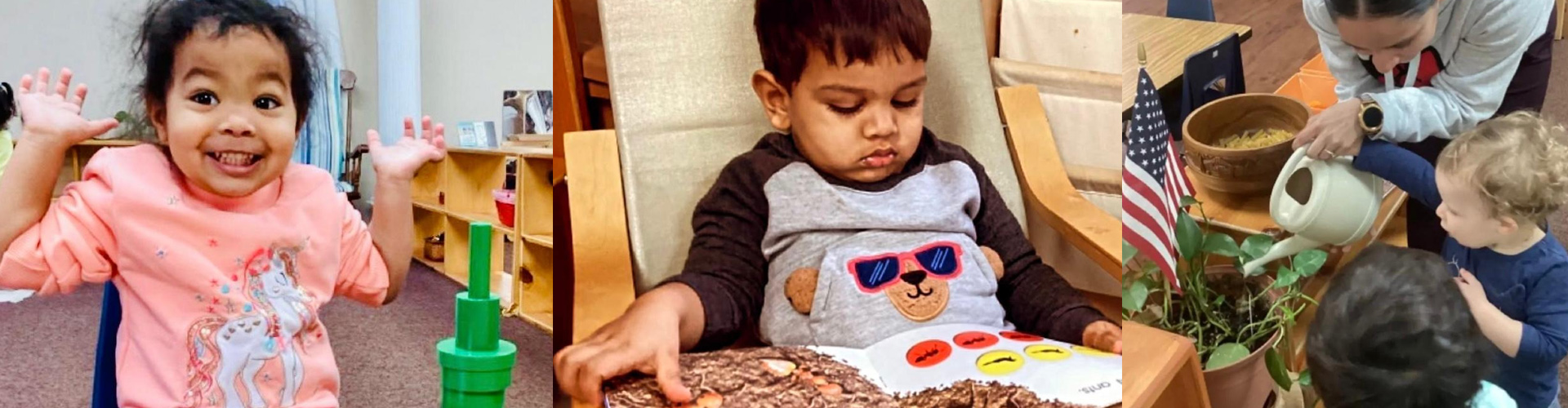
Toddler Montessori Program
At Banyan Montessori Academy, our Toddler Montessori Program, fosters children’s natural drive for independence in a fun, relaxing, and social environment.
Designed for ages 12 months to 3 years, the classroom promotes self-reliance, cognitive growth, and motor skills development in a rich, well-prepared space.
Our nurturing, trained teachers implement a toddler-focused curriculum to encourage speech and language development, grace and courtesy lessons, and practical life skills like handwashing and dressing.
With our utmost consistency in schedule, staffing, and attendance, children thrive in an environment of order and bonding. Toddlers attend five days a week, and before/after care is available.
They transition smoothly into the Primary program upon completion.
Toddler Curriculum:
Peace Education
Peace making and conflict resolution are a daily part of the Montessori curriculum. The Peace shelf is full of lovely, interesting and calming objects from around the world, like music boxes, smooth stones, or tiny flowers, for children to touch and hold. There may be a mirror, so children can see how they look when they experience different emotions, and books with peaceful messages. At the Peace Table teachers help children to be good listeners and forge mutually agreeable solutions to conflicts through a peace bear and peace rose. It is also a place where children can choose to go to enjoy a peaceful moment alone.
Every day Living
This area forms the cornerstone of the Montessori classroom and prepare the child for all other areas. The emphasis is on process rather than on product. Through the repetition of Every day living activities, children develop and refine the basic skills that will serve them all their lives. The Toddler classroom offers the early Every day living exercises, such as Pouring, Opening and Closing, Spooning, Bead Stringing, Polishing and Large Water Activities. These activities are aimed at enhancing the child’s development of fine motor control, hand-eye coordination, balance, sense of order, concentration and independence.
Grace and Courtesy
In our classrooms, children and adults take care to be gracious toward and courteous of one another. This area of the curriculum encourages respect for oneself, for other members of the community, for the living things in the classroom, and for the environment. Carrying things carefully, returning them to their place so others may use them, moving gracefully and carefully, using polite and respectful language, showing consideration to others, good table manners, properly introducing oneself, and interrupting politely are all part of the lessons in Grace and Courtesy.
Sensorial
Young children learn through their senses, they begin to take in and understand the world around them through their senses. Sensorial activities assist Toddlers in the great task of organizing, integrating and learning about their sensory input. Sensorial materials include Knobbed Cylinders for practice with dimension, Pink Cubes, Color tablets, tactile exercises like Rough and Smooth, Musical Equipment, Sorting and Shapes, olfactory exercises like sound matching, gustatory exercises like distinguishing smells etc.
Math
Math exercises in our toddler classroom , encourages the development of important pre-math skills such as order, sequence, visual discrimination, sorting, one-to-one correspondence and directionality. Toddler Math activities include stacking and nesting cubes, number blocks and puzzles, and sorting and counting materials, and sand paper numerals.
Language
The Language materials in the Toddler classroom encourage the refinement and enrichment of language as the first steps on the road to writing and finally reading. Early Language materials and oral exercises like storytelling and reading aloud support the toddler’s need to be immersed in language. Activities include books, puzzles, naming objects like fruits, vegetables and animals, and beginning sound games. Toddlers are exposed to wide variety of rhymes and songs and finger plays which aids in language development and building vocabulary.
Geography/Science
This curriculum helps toddlers explore the world around them. Children explore the nature, weather, animals, and plants with hands-on materials. These activities help them discover how things work and build curiosity about the world.
Art
Toddler Montessori art focuses on hands-on, sensory-driven experiences that encourage creativity and fine motor development in a natural, self-directed way. In a Montessori environment, toddlers engage with simple, open-ended art activities like drawing, painting, and molding clay, where they can explore different textures, colors, and tools at their own pace. The emphasis is on process rather than the end result, allowing children to freely experiment and make choices. By using child-sized materials, such as small brushes, paper, and natural mediums, toddlers develop independence and concentration, while also strengthening their fine motor skills and hand-eye coordination in a calm, orderly space. Additionally, each month, toddlers explore the work of a different artist, learning about various styles and techniques. This introduction to artists fosters an appreciation for creativity and diversity, inspiring children to experiment with new ideas and express themselves through their own unique art forms.
Music
Toddlers and Primary children enjoy music classes learning concepts such as beat, meter, and rhythm. Introduced to different types of musical instruments.Toddlers learn to use their bodies with the rhythm of the music.
Theater
Toddler Montessori theater focuses on imaginative play and self-expression, allowing young children to explore roles, emotions, and stories through acting and movement. In a Montessori environment, toddlers are encouraged to engage in simple dramatizations, often using props like dolls, puppets, or costumes, to bring stories to life. The emphasis is on open-ended, child-led play, where toddlers can experiment with different characters, scenarios, and actions. This type of theater helps develop language skills, empathy, and social
understanding, as children work together in role-playing activities and learn to express themselves creatively. It also nurtures confidence and helps build foundational cognitive and emotional skills.
Gardening
A BMA, gardening is a hands-on activity that connects children to nature and teaches them responsibility, patience, and a sense of accomplishment. We have raised vegetable beds that we begin cultivating in April and maintain until October. Both indoor and outdoor vegetable gardens are incorporated into the curriculum, allowing children to plant seeds, water, and care for the plants as they grow. They learn about the lifecycle of plants, the importance of healthy soil, and how different plants require different care. As the garden
flourishes, children also participate in harvesting, which reinforces their understanding of cause and effect, as well as the value of hard work. Gardening fosters a sense of independence, environmental stewardship, and an appreciation for where food comes from.
Cookery
In our Toddler Montessori classroom, cooking and food preparation activities are an integral part of daily life, offering children a chance to develop practical skills while engaging with food in a meaningful way. Toddlers might pick grapes, slice bananas, tear lettuce for salad, or wash vegetables, refining their fine motor skills and hand-eye coordination through these hands-on tasks. These activities not only teach them the importance of healthy eating but also encourage independence, concentration, and responsibility. When combined with gardening,
where children learn to nurture plants and harvest their produce, toddlers gain a deeper understanding of where food comes from. Gardening and cooking together promote patience, sensory exploration, and teamwork, as children experience the full cycle of food from garden to
table, fostering a sense of accomplishment and pride in their contributions.
Gross Motor
Children are provided with a perfect natural environment to develop their large motor skills. Toddlers are guided into nature walks, explorations and fun.
Spanish and other international languages
Toddler, Pre-Primary, and Kindergarten friends are exposed to the sounds and rhythms of international languages through games, songs, and activities. Lessons include counting, colors, fruits, vegetables, and basic vocabulary. We have a diverse group of staff and parents who share languages like Hindi, Mandarin, and Spanish, enriching the learning experience.
Community Service
We serve the community by doing a food drive twice a year and we also gift wrap and donate gifts to the children at Detroit Medical Center in December.
Banyan Montessori Academy
6215 N.Canton Center Rd.,
Canton, MI 48187.
Phone: 734-756-8774.
Email: shiva@banyanmontessori.com